Do ATS reject two-column resumes? What the parser does
No ATS documents rejecting a resume for its layout. Greenhouse does list columns as a cause of a failed parse. What that costs you, and how to check your file.
No. No applicant tracking system documents rejecting a resume because it has two columns. Automatic rejection, where vendors describe it at all, is a rule on your answers to the application form, not on your layout.
That is not the whole answer, though. Greenhouse, one of the most widely used systems, lists "resumes that have a columned layout" as a cause of an unsuccessful parse. A failed parse does not reject you. It leaves your candidate profile empty until a recruiter types your details in by hand. That is a smaller risk than the one you were warned about, and a more real one.
What Greenhouse actually says about columns
Greenhouse keeps a help page called "Unsuccessful resume parse", last updated on 2 March 2026. It lists the formatting that causes trouble, and columns are on it, next to these:
- "Complex resumes with tables, headers, and footers"
- "Resumes with the name and contact information in the header, footer, or text box"
- "Resumes that have a columned layout"
- "Resumes that include graphics, photos, or word art"
The same page says what happens next. The resume "has only been attached to the candidate", and "you'll need to manually input the candidate's details into the fields."
Read that as a recruiter would. Your file is there. A person can open it and read it. But the structured fields the system fills from a good parse, your name, your employers, your dates, are blank or wrong until somebody fixes them. The layout risk is extra work for the recruiter and a messy record, not an automatic no.
Most articles on this question quote vendor tests instead. Two of them reach opposite conclusions about the same layout, and neither publishes enough to repeat. A support page that tells recruiters what to do when parsing fails is a better source, because Greenhouse has no reason to make it up.
Why columns go wrong: reading order
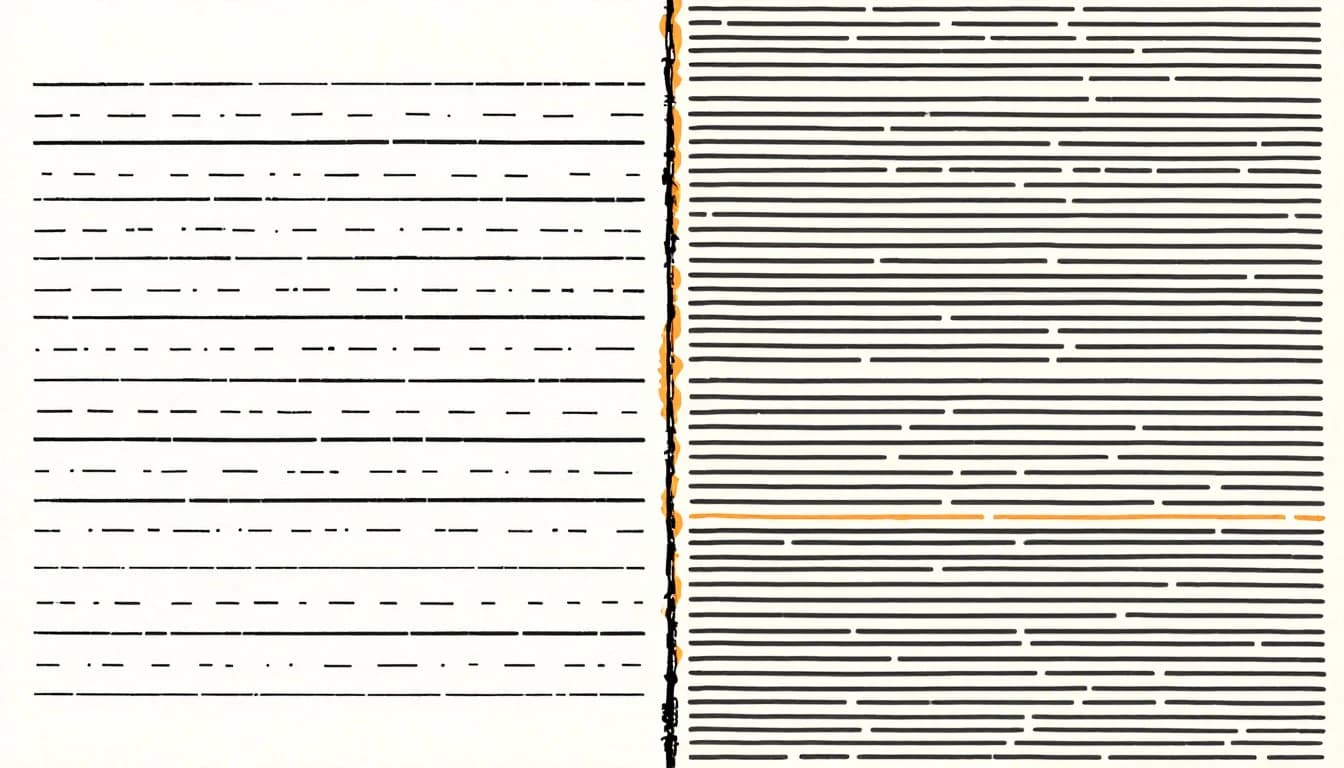
A parser's first job is to turn your file into one stream of text. Reading order is the sequence it puts that text in. On a single-column page there is only one sensible order: top to bottom. On a two-column page there are two, and the parser has to guess which one you meant.
When it guesses wrong, it reads straight across the page. Here is a fictional two-column resume:
Senior Analyst                     SKILLS
Harbour Logistics                  SQL
2021 to present                    Python
Built the weekly freight report    Forecasting
Read left to right, line by line, it becomes this:
Senior Analyst SKILLS Harbour Logistics SQL 2021 to present Python
Built the weekly freight report Forecasting
Every word is still there. The relationships are gone. "Harbour Logistics SQL" is not an employer, and the dates now sit between two skills. That is how a date ends up in the wrong field, and it is the failure our own parse step names when it happens: a two-column layout broke the reading order.
How common is this? A 2025 study by Zhu and colleagues reports that about 20% of the resumes they analysed use "non-linear, multi-column layouts". The paper does not say how that share was counted, so treat it as one team's estimate. The more useful number is what fixing the order is worth. In their test on 13,100 real resumes, adding a layout-aware step before extraction raised one model's accuracy from 0.919 to 0.959 F1. That removes about half the remaining error. Columns do not make parsing impossible. They make it measurably less accurate.
Rejected or misread: the difference
| What you were told | What is documented | What it costs you |
|---|---|---|
| The ATS rejects two-column resumes | No vendor documents a layout-based rejection. Greenhouse and Ashby document auto-reject on form answers. | Nothing, because it does not happen that way. |
| Columns confuse the parser | Greenhouse lists a columned layout as a cause of a failed parse. Research measures the accuracy loss. | Empty or wrong fields until a recruiter types them in. |
| A column layout is unreadable | The file stays attached, and a person can still open it. | A recruiter sees your resume. The system may not know what is in it. |
If you got a rejection a few minutes after you applied, the layout is the least likely cause. What happens in those few minutes names the mechanism that does fire that fast.
How to check your own resume in two minutes
You cannot run a specific company's parser. Nobody outside that company can. You can see whether your file has an unambiguous reading order, which is the thing that goes wrong.
- Paste it into plain text. Open your PDF or Word file, select all, and paste into a plain text editor. This is not what any ATS does, but it shows the order your file stores its text in, and that is the order a simple extractor starts from.
- Read your work history top to bottom. Each job title should sit next to its own employer and its own dates. If skills, languages or contact lines are woven between them, a parser may weave them too.
- Find your name, email and phone in the body. Greenhouse names the header, the footer and text boxes as places contact details get lost. Moving them into the main text costs nothing.
- See an actual parse. Upload your resume to Rzume. The parse is free and needs no account. It shows the fields it read and lists each one it could not place, with the reason, such as a two-column layout or a header. It is our parser, not Greenhouse's, so it tells you whether your layout is ambiguous, not what one employer's system will do.
Should you switch to one column?
Our view, which no study settles: only if the check above fails.
A single column has one reading order, so it removes the risk entirely. But if your text already comes out in the right order, rebuilding the layout buys you very little. Spend that hour on the words instead. Whether your resume answers what the posting asks for matters to the person who decides, and that person reads the file, not the fields.
If you keep two columns, put the part that matters most in the main one. A skills list that comes out scrambled costs you less than a work history whose dates have come loose from their employers. And if you are tempted to move keywords into a side column so the software finds them, which words actually have to match is a shorter list than you think.
Columns are one of three things worth checking before you apply. The other two, and how to check each one, are in is my resume ATS friendly.
See what the parser read
The quickest test is the real one. Upload your resume and Rzume shows you the parse before it says anything about your writing. If a column broke the reading order, you will see which field it broke and why.
Sources
- Greenhouse, Unsuccessful resume parse, last updated 2 March 2026.
- Zhu, Yu, Chen, Zhou, Ji, Yang, Zhang, Hu and Liu, Layout-Aware Parsing Meets Efficient LLMs: A Unified, Scalable Framework for Resume Information Extraction and Evaluation, arXiv:2510.09722, submitted 10 October 2025.
- Greenhouse, Auto-reject, and Ashby, Auto-reject applications.
All accessed 24 October 2026.